Surprising statistic: a well-configured exchange account can prevent more loss than a single profitable trade—because most surviving traders lose money to operational failures, not just market moves. That counterintuitive idea sets the frame for this explainer: if you trade OKX from the U.S., understanding how the platform’s Web3 features, futures products, and login/security layers work together is more important than any short-term signal. This piece breaks those systems down to mechanisms, trade-offs, and practical guardrails you can actually use.
I’ll assume you know basic terms like spot, margin, and wallet; the goal is to translate the platform’s capabilities into a mental model for managing risk and opportunity. Expect concrete decision heuristics, a clear map of where OKX’s protections stop and user responsibility begins, and a short watchlist of signals that would change the calculus for U.S.-based traders.
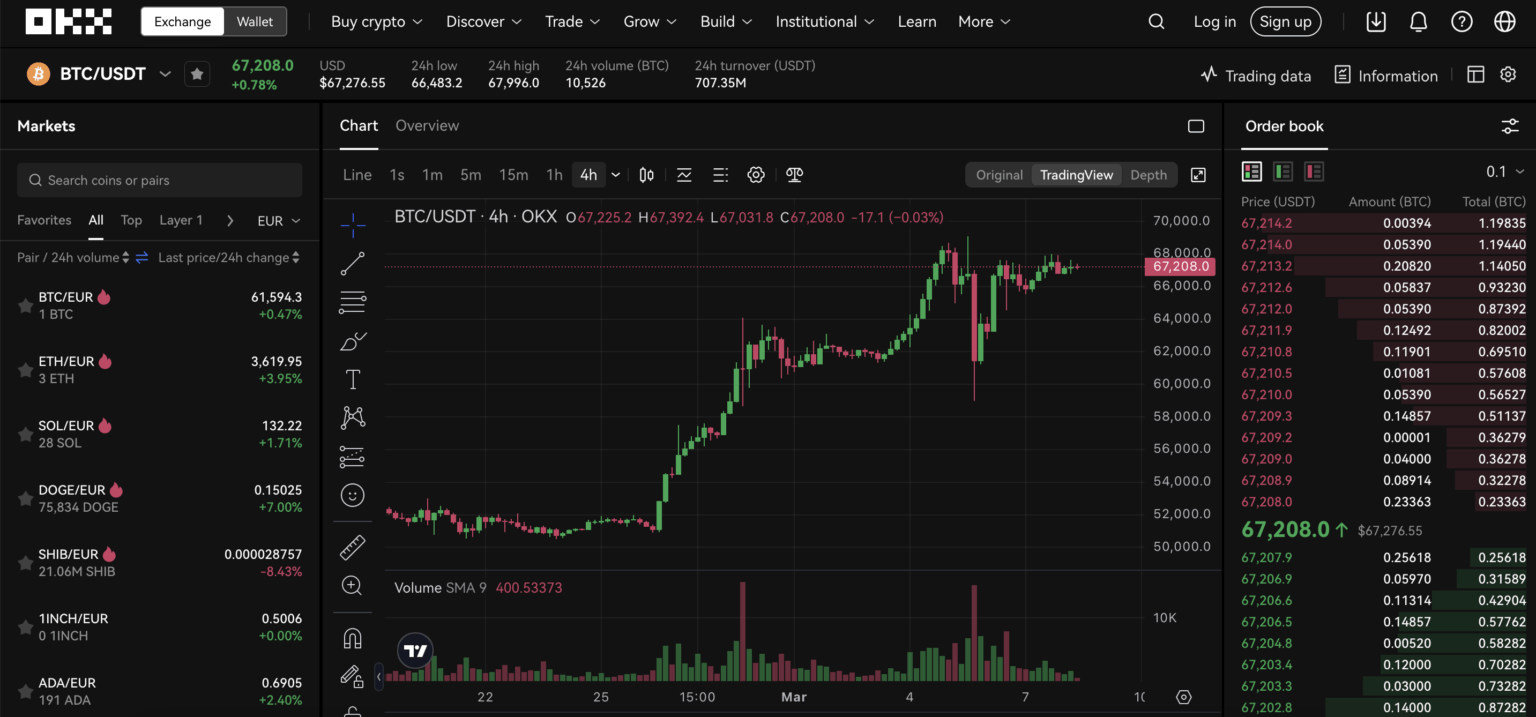
How OKX’s Web3 and CEX components are stitched together (mechanisms)
OKX is both a centralized exchange (CEX) and a Web3 platform; that combination matters because it creates two distinct custody and security regimes under one roof. Mechanically, most user deposits on the exchange are custodial (held by OKX in pooled accounts), while the Web3 wallet option is non-custodial—meaning private keys live with the user unless they choose the exchange’s custody. OKX mitigates custodial risk with a cold-storage architecture: over 95% of assets are kept offline in air-gapped, multi-signature cold wallets. That design reduces large-scale hacking risk but does not eliminate user-level attack vectors like phishing, credential compromise, or social engineering.
On the Web3 side, OKX supplies a non-custodial wallet compatible with hardware devices (Ledger, Trezor) and a browser extension for DApp interactions. The bridge aggregator and DEX routing use liquidity from major DEXs to optimize swaps and cross-chain transfers. Mechanically, a swap can involve on-chain approvals, wrapped tokens, and cross-chain messaging—each of which introduces smart contract risk, slippage, and possible front-running in volatile markets.
Futures & derivatives: leverage mechanics, margin modes, and where liquidations bite
OKX offers quarterly futures, perpetual swaps, and options with leverage up to 125x on certain contracts. That headline number is a mechanism, not a suggestion: higher leverage compresses the price move needed to wipe a position. Two margin regimes—isolated and cross—change how loss cascades. Isolated margin limits loss to a single position’s allocated collateral; cross margin pools collateral across positions, which can be efficient but allows one collapsing trade to eat margin for others.
Practically, use these heuristics: (1) Reserve high leverage for ultra-short-term, well-studied strategies; (2) prefer isolated margin when running concentrated directional bets; (3) expect slippage and wider spreads during sudden moves—liquidity can evaporate even on major assets during systemic events. OKX also has automated liquidation mechanics tied to maintenance margin; those are deterministic but can execute at worse-than-last-trade prices when order book depth is thin.
Options and quarterly futures add hedging flexibility, but options pricing relies on implied volatility models that break during regime shifts. Traders should treat options as insurance with cost (premiums) rather than free optionality.
Account protection, login flows, and the residual attack surface
Login security on OKX layers military-grade encryption, AI-driven anomaly detection, and mandatory Two-Factor Authentication (2FA) via SMS, Google Authenticator, or biometrics. From a mechanism perspective, AI detection reduces the window in which an attacker can use stolen credentials, but it also risks false positives that can lock a legitimate user out during high-volume market moves—an operational trade-off worth noting for active traders.
KYC is mandatory: expect to upload government ID and complete a facial liveness check. That increases friction but also creates a higher barrier for on-platform illicit activity; it also means U.S. users must weigh privacy and regulatory exposure. Proof of Reserves (PoR) gives an on-chain transparency signal that OKX holds 1:1 backing for deposits—this reduces some systemic counterparty risk, yet PoR is not a panacea. It demonstrates backing at a snapshot in time but cannot prevent nimble internal fraud or mismanagement of off-chain liabilities that are not visible on-chain.
If you need a short, practical path to log in and check account settings, OKX provides cross-platform access: web with TradingView charting, mobile apps with biometric login, and a browser extension. A centralized login session plus a non-custodial wallet in the same device invites mixed-threat scenarios: an attacker who compromises the browser can phish both exchange credentials and seed phrases if the user is careless. Segregating duties—use a hardware wallet or a dedicated device for large-held assets and a separate device for active trading—reduces this compound risk.
For U.S.-based traders specifically: always confirm the exact OKX domain, avoid public Wi-Fi for logins, prefer app-based biometric 2FA over SMS when possible (SMS is vulnerable to SIM swapping), and keep a verified recovery plan for KYC-related account recovery—losing access without an established recovery path can be slow and costly.
Where OKX’s protections stop: user responsibilities and DeFi interactions
OKX protects custodial assets through cold storage and multi-sig approvals, but when you move funds to DeFi protocols—whether through the DEX aggregator or a direct wallet connection—you inherit smart contract risk, oracle manipulation risk, and permanent-loss scenarios. Mechanistically, an on-chain bridge or DEX route may require token approvals that, if granted with infinite allowance, permit a malicious contract to drain assets. OKX’s wallet UX can help by reminding users about approvals, but the underlying permission model is the user’s responsibility.
Another boundary condition: PoR covers assets held by the exchange, not tokens minted or locked in third-party contracts. If a project in the OKX ecosystem is exploited, that loss may not be reflected in exchange reserves. Similarly, staking and yield products—though convenient—carry counterparty and smart contract exposures. Treat yield like a credit exposure or insurance purchase: higher yield often equals higher protocol or counterparty risk.
Decision heuristics and a reusable mental model
Here’s a compact framework you can apply: Custody = Control x Risk. When control is centralized (exchange custody), operational protections multiply (cold storage, PoR), but the single point of failure becomes the platform’s internal ops and your login hygiene. When control is decentralized (self-custodial wallet), operational protections fall to you, but systemic platform insolvency risk is removed. Adjust position sizing and operational procedures accordingly.
Concrete heuristics:
- Small, active funds: keep on-exchange but enable the strictest 2FA and session controls; use isolated margin for risky leveraged trades.
- Medium-term holdings: use exchange staking for convenience but keep an emergency withdrawal plan and monitor PoR reports.
- Long-term or high-value holdings: prefer hardware wallets and non-custodial storage; only connect to DeFi when necessary and audit contracts or use vetted aggregators.
To streamline first-time setup and avoid common pitfalls when logging into OKX, this walkthrough is useful for checking step-by-step procedures and settings: https://sites.google.com/cryptowalletextensionus.com/okx-login-web/
Where this could change: signals and near-term implications
Recent market and industry signals matter. This week another major institutional involvement was reported, indicating deeper traditional finance ties into OKX. Institutional capital can improve liquidity and compliance posture but may also drive tighter regulatory scrutiny in the U.S. If regulated partners push for more conservative custody or reporting practices, product availability (e.g., high-leverage contracts) could be adjusted. Monitor three signals: (1) product notices from OKX about contract or leverage changes; (2) PoR cadence and any structural changes to custody disclosures; (3) regulatory guidance in the U.S. about derivatives on offshore venues. Each would change how U.S. traders should size leverage and structure custody.
Finally, technical signals to watch: active-address counts on supported blockchains, sudden delists of assets with low liquidity, and changes in margin maintenance requirements. Each of these is a real-time indicator about liquidity and risk appetite on the platform.
FAQ
Is OKX safe to log into from the U.S.?
Mechanisms like cold-storage, PoR, and AI-driven login monitoring materially reduce systemic risk, but safety depends on user practice. Use hardware wallets for large holdings, enable strong 2FA (prefer app or biometric), verify domains, and avoid public networks. Safety is joint responsibility—platform protections plus disciplined user behavior.
How risky is trading OKX futures with high leverage?
High leverage amplifies both gains and losses. With up to 125x leverage available on certain contracts, the liquidation price can be only a small percentage away from entry. Prefer isolated margin for concentrated bets, size positions so that a single adverse move won’t wipe your portfolio, and always model worst-case slippage—liquidation can execute at worse-than-expected prices in thin markets.
Does Proof of Reserves mean my funds are guaranteed?
No. PoR shows on-chain backing for exchange-held assets at snapshots and increases transparency, but it does not guarantee against internal mismanagement, off-chain liabilities, or future adverse events. Treat PoR as a strong signal, not an absolute guarantee.
Should I keep assets in the OKX Web3 wallet or on the exchange?
There is no single right answer. Use the exchange for frequent trading and margin operations; use the Web3 non-custodial wallet for long-term custody and direct DeFi interactions. Split assets by time horizon and risk—think of the exchange as a trading hot wallet and the Web3 wallet as cold storage if you want lower systemic exposure.
Takeaway: OKX provides a sophisticated stack—cold storage, PoR, a Web3 wallet, a DEX aggregator, and deep derivatives markets—but those mechanisms only reduce specific failure modes. The remaining vulnerabilities are behavioral (phishing, device compromise), protocol-level (smart contract bugs, bridge risk), and regulatory (changes to product availability). U.S. traders who combine platform protections with disciplined custody segmentation, conservative leverage, and a watchlist of platform signals will reduce preventable losses more effectively than chasing marginal alpha.